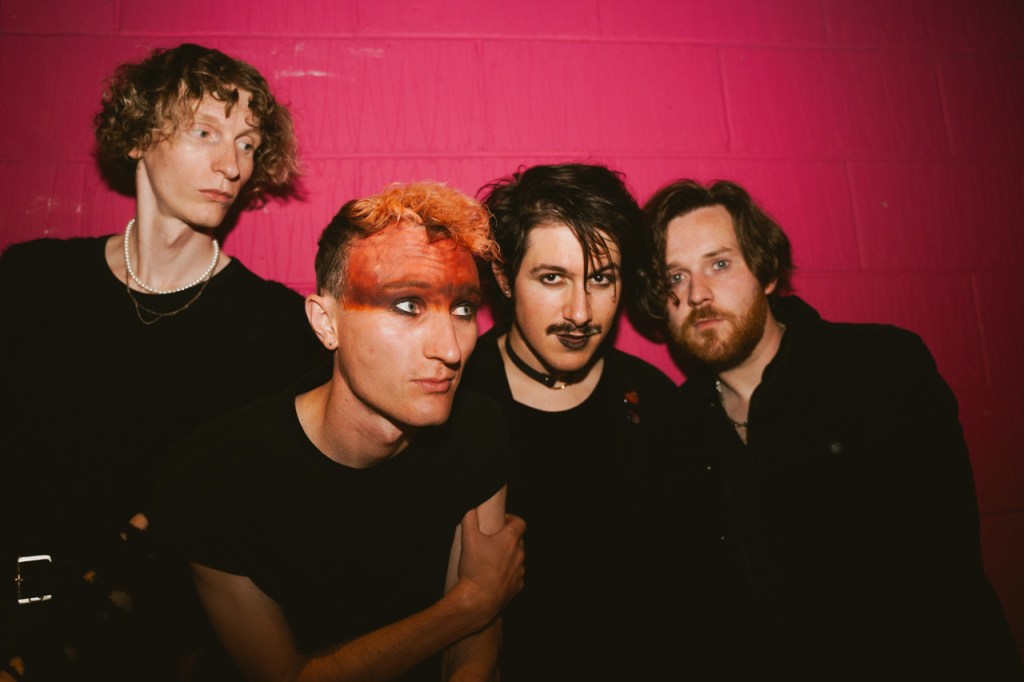
Late last month, we caught up with Thirst following their supporting set for False Thoughts. Conversation turned to new music, the best coffee, the logistics of a Nigel Farage piñata, and just what it means to defy expectations in the age of the algorithm…
Even after all this time, I still remain unconvinced that Thirst aren’t simply four immortal vampires that have simply decided to mess around with the Merseyside music scene. Despite having just finished up long days at their workplaces, the four-piece were immaculately dressed and styled for this interview; jet black nails are complimented by subtle eyeshadow, suits accompanied by neckerchiefs, hands bejewelled with rings. I felt woefully underdressed for this affair, despite the fact I should have known this would be the case; Thirst are not a band that do things by half measures.
Their support slot for local heavy outfit False Thoughts had been the perfect demonstration of this; in a set that could have easily been a headliner in and of itself, Thirst brought a fantastical display of chaos to the Kazimier Stockroom, with saxophones, piñatas, and pits. It was a theatrical display of punk-adjacent fury, which vocalist Oli confirmed was the intention.
“The idea and ethos of Thirst is bringing the theatrics of the stuff I listen to. I think we’re past four dudes on a stage, thrashing about” he says, pointing to acts such as the legendary My Chemical Romance as influences. He then continues; “My attention span is not held by just blokes on a stage. My attention span is held by… if the clothes you’re wearing match the beats you’ve got, match the things you’re talking about, match the smoke machines…”. Bassist Sol agrees with him, pointing to the fact that even some of the classic punk bands had an element of pageantry to them; a desire and a drive to put on a show, rather than merely a gig.
“I was kind of surprised by the first videos I saw back of us performing live, our first show, I was like, ‘wow, we’re actually kind of punk!‘” adds guitarist Igor. Further noted influences such as The Cramps and Siouxse continue to point to the punk roots of the band’s persona and artistry, although the band are clear that their ethos is one of originality, not reliant upon their influences or genre labels. “I don’t think we ever hear a song and think ‘let’s make a song like that‘,” says drummer Patrick, “it’s just what is naturally coming out”.
This clear to hear on the band’s two current singles, ‘Pale English Hands’ and ‘Paycheck’; sitting aggressively and unsettling in some surprising intersection between Creeper and Yard Act, the band’s striving for originality has lead to them to some fantastical sonic locations. That only promises to continue as the band go forwards, with new music arriving next year.
Already a part of their live set, the band plan to release their third single ‘This Body’ in early 2025. Speaking on its themes, Oli stated that the track is an “exploration into [his] gender dysphoria, which [he’s] always felt on some level since [he] was a kid.” The track represented a moment of introspective pause during the band’s live set, with acoustic guitars taking over from the saxophones and glitter, whilst Oli’s hauntingly melancholic yet enchanting vocal performance takes centre stage.
“Coming from a small town in the Wirral, that wasn’t really a term, or a thing,” speaks Oli of his gender dysphoria, “you were ‘gay’ or you were ‘straight’, they were the two options; there was no questioning of gender. So it’s about my… late onset exploration of gender dysphoria, and a love song to my fiancee, to say thank you for helping me through that.”
“I think that… in a way, being ‘queer’, if you want to use that word, is… it’s part of being in the punk scene,” further expands Igor. “Like they sort of… spearheaded the whole thing, like… that’s the most punk thing to be, to be different and to present it in a way you’re proud of.”
This sense of remaining true to oneself is foundational to how Thirst approach music. Whether through physical expression or stylistic choices, the band make it clear that authenticity, and the freedom to be authentic, is a core message of their work. In talking about their previous show with False Thoughts, Sol explains that he feared that the audience would have smelt a lack of authenticity like the scent blood to a shark. “I was terrified of that gig because… I kind of came from that crowd, and I know what crowds like that are like,” he says with a nervous laugh. “I thought ‘we could get eaten alive here‘.”
The fear, however, came from a place of love for the heavy scene. “That kind of audience are into music that only music fans are into. People don’t just occasionally listen to hardcore, you are INTO hardcore,” explains Oli. “They’re the best people to play to, because they’re receptive to listening to other shit, and they’re in it for the long haul. I was really kind of surprised at that hardcore gig that people were so interested in hearing something different, but in hindsight, they’re the perfect people to play to; they’re excited about music.”
It is also here that Patrick perhaps offers the most succinct yet informative look into the machinations of Thirst: “We want strong reactions; love us, or boo us off stage. We don’t want anyone to watch us and be like ‘well, that was alright’. We want to be your favourite thing in the world.”

It perhaps goes without saying that existing as anything less than a megastar in a musical landscape dominated by streaming and algorithms is a challenge, let alone for a small band so intent on defying all demands made of them. Despite that, the band remain focused and driven. “If you care enough and you want it, you do it,” says Sol. “I think we’ve definitely all got that attitude.”
Even in the face of low streaming numbers, the band remain resolute, and are able to acknowledge the truth that simple numbers on a screen are no true measurement of impact. “We’re doing our own thing, we can do whatever we want. Every time we play a gig, everybody is responding to it, and… the real music fans are the ones that go to these DIY gigs, not people who stream it on Spotify,” Patrick says, “whilst it is frustrating to see the numbers low, you’ve just got to have that faith that people are watching you and will respond.”
It’s not simply their music that the band seek a response to, however. From the vicious lyricism of their two singles, to the presence of a Nigel Farage piñata at their live show, Thirst seek to challenge and engage at every opportunity. Upon being asked about the piñata, Oli can’t help but laugh, before vaulting into a rant about the seemingly irrepressible nature of the politician, and the fact that the piñata in question had been gathering dust for quite some time. “I had this idea about three years ago,” he begins, “and then he fell into an aether and promised he’d never be in politics again, and then the fucker… came back! Crazy to imagine him lying or going back on his word! Came back, became a politician, got a seat in fucking parliament…!”
The humour and catharsis of beating an effigy of a racist fascist aside, the band are acutely aware that only so much can come from preaching to crowds that already denounce the rise of the far-right. The band are eager to challenge the way people think, and offer them a chance to reconsider the beliefs that they have been fed. There’s a resolute toughness in their words against fascism, but also a deep sadness for communities that have been sucked in to hateful beliefs by systematic decline. “I know we keep talking about being from a shithole little town on the Wirral,” says Patrick, speaking on the hateful sentiments that let Reform gain a foothold, “but I think it’s quite easy to forget that in areas that aren’t a little punk scene… it’s still rife.”
That isn’t to say that Thirst have forgotten their own punk community. Speaking on musicians within the local circuits that deserve attention, Oli is quick to point to industrial dance project Dead Animals, fronted by Ruby Roadkill. The band also note TWO TONNE MACHETE, a band they are playing alongside for a future concert, as being an exciting punk act worthy of attention. None of the band, however, seem to be aware that Liverpool as a city entered the year with ‘music city’ as a primary slogan.
“Liverpool claims to be like… the capital of music, and in 2008 it was the Capital of Culture, yet there is very little support, funding… what’s the word… nurturing of any sort of grassroots talent,” says Sol. “All that we seem to get in return is venues, and spaces, and opportunities to share those things, taken away from us, and I feel like as a city, they absolutely can do better. But… I’m lead to believe it’s just a steady, slow decline.”
Perhaps what is most painful about this statement is the fact that between being spoken and this interview being published, Liverpool’s Quarry venue has announced its plans for closure, after the site was sold for luxury flats; the band had mentioned this specific venue, alongside The Jacaranda, Kazimier Stockroom, and Sound as being some of their favourites on the local circuit. “They might not have the best sound system in the world,” Sol elaborates, “but the energy in those rooms feels so much better when it’s just… a little bit dirty.”
Should the impending collapse of the music scene come to fruition, however, perhaps the band can make it big as baristas; rounding things up with a question on what their go-to coffee is, Oli is quick to add coffee brewing to Igor’s seemingly endless list of talents.
“So,” he begins, eyes suddenly sparkling with a charming intensity in regards the ritual he is about to discuss, “in the morning, whenever we’ve got rehearsals or a big gig day, I get Sol first from his home in Anfield, and then I come and get these boys who live above a club in town, and then, without fail, Igor the Spanish vampire will come down with a coffee each! Just a home made fucking… I don’t know what it is… like a teeny-tiny cross-between a flat white and a cortado, with the carabiner on the end… Igor coffee!”
Of course, Igor has competition. Oli is also willing to point to the ‘fucking brilliant’ coffee of Dovedale Bagelry, whilst Sol champions the brewing abilities of Bold Street Coffee, whom have expanded across the north west. For a group of four immortal vampires whom have no doubt tried some of the finest coffees across time, their recommendations are no doubt worth paying attention to. One might even say it’s coffee worth having a Thirst for.
—
Want to read the interview in their own words? Check out the transcript below; promises of 100% accuracy cannot be made due to background noise in the venue.
Follow the band on social media at the following links:
—
R: The first thing I want to say is that the show with False Thoughts was absolutely fantastic. How you guys you presented yourselves, it felt like you were putting art back into punk; is that the basis of Thirst or…?
O: I think so. The idea and ethos of Thirst is bringing the theatrics of the stuff I listen to like My Chemical Romance… I always love the full function of a band that can have their aesthetic and their show as a ‘show’.
R: So keeping the raw edge of punk whilst bringing it to a theatrical point?
O: Yeah, I think we’re past four dudes on stage thrashing about.
S: I think it’s quite funny because when I was younger, to be a music guy, you had to be that kind of… cutting, hard punk. But then kind of… as you mature you realise that some of the best bands that did that an element of pageantry to it.
I: I was kind of surprised by the first videos I saw back of us performing live, our first show, I was like ‘wow, we’re actually kind of punk!’. We think of all of the little things and like, really think of our performance and the tiny details… in a way it’s like, very elaborate, which doesn’t feel very punk, but then we actually performed and watching it back… that does feel punk, whilst it didn’t feel punk when we were doing it.
R: I think, especially these days, there has been a push towards avoiding those clear cut genre expectations, and how you guys have embraced that in your performance really shines through. As you say yourself, there is an element of refusing to adhere to one expectation or sound. Speaking on that, what kind of influences do you actually pull from? I know you mentioned My Chemical Romance…
I: We have very conflicting…
S: We argue quite a lot actually! [Laughs]
I: Like… I don’t like My Chem, but it’s like one of Oli’s favourite bands. So I will probably be pulling from like… the 80’s sort of… gothy punk sound of like… Siouxse and The Cramps and like that. We make it work with ‘in-betweens’ where we actually… connect, we confer.
S: I love Italian disco.
R: Very specific!
S: I love Italian disco from the 80’s.
R: Okay, go on, let’s unbox that one!
S: Let’s not! [Laughs]
P: The thing that you were just saying before about genres, like… a good tune is a good tune. Like, it doesn’t really matter if it’s this or that. When you’re creating art, that’s always in your head, isn’t it? I don’t think we ever hear a song and think ‘let’s make a song like that’, it’s just what is naturally coming out.
R: So a marriage of those kind of influences, and whatever comes out at the end is…?
P: I think we’re just as influenced by films as we are albums.
R: I just want to talk about how that theatrical element to your band… it is very clear on stage. Did that come about naturally, or was it a conscious show that you were going to go on there and put on a ‘show’, not just a gig?
O: Yeah, my attention span is not held by just blokes on a stage. My attention span is held by… if the clothes you’re wearing match the beats you’ve got, match the things you’re talking about, match the smoke machines, it’s… the band’s I’ve seen that are memorable to me are the bands that have done that. Like Patrick said about films… the films that keep my attention… four minutes in, I’ve got ADHD in there, it’s like… you need something to fully immerse you, so… all of those elements are tackled at the same time, that’s what grabs me. I guess that’s why I’ve chosen to that.
S: It’s a weird one because I think maybe like… at first we didn’t think about it that much, and then obviously when we played our first gig, it kind of became a thing, the wheels started moving then. We had lights and stuff arranged for it, and once we had that kind of trial run, we then took that pull. We were sitting on the music for like… a year, two years… so that’s kind of an ongoing thing. I feel like the music’s been there for a while, and we’re still working on that stage show. But it’s paying off, I think.
I: I think I… I just feel like I love to perform, and first time playing with these guys, I was like… ‘oh, we are performing!’. It’s not just playing music, we are putting on a show. So it’s like… that’s what I love to do! [Laughs] So I’m like, all for it. It’s one of the reasons I love this band so much, because we can put on a show, not just make music.
R: So you were all kind of… established musicians before this point, or…?
All: Yeah.
S: So Igor’s got a solo project called ‘Evil Pink Machine’. Erm… [to Oli] do you want to talk about what you used to do?
O: I’ve done previous things; I was in a band called ‘Pink Footage’, one called ‘Lenny Dies’… me and my brother were ‘Swearwolves’ when we were sort of… eighteen. We’ve been at this for a while.
S: I was around in some like… a little bit more hardcore bands like… there’s a band called ‘Haiku Waifu’ I did some things for and uh… my old band was called ‘Kin’. So we were around for a little bit as well.
R: I was going to say because you don’t become a saxophone player without having some experience [in reference to their recent local performance with False Thoughts].
I: Yeah, I have many years of experience! [Laughs] I think I’ve done anything and everything… I don’t know what’s left for me to try, and I think… I started playing punk when I started playing guitar, and then as you develop musically, punk becomes a thing that you leave behind and you start playing different genres, and like… you do other things. But then suddenly I found myself really coming back to it, and then I found these guys and… this is right up my alley.
S: Igor was always definitely the missing piece, I just want to mention that! Because we were doing this for like, a year and a half, we trialled maybe… four guitar players. And then… Igor was kind of like, the missing piece that was right under our noses. We found him and when the first practice happened, we were like, ‘oh, this is it! This is what it was meant to be!’.
R: That chemistry was very clear on stage. You all have a similar vision, a similar drive that is pushing towards a specific point. It’s interesting how you mentioned how you returned to punk. I feel as though there has been a big push towards post-punk and new-wave, gothic aesthetics in alternative subcultures… is that something you have been consciously aware of when making music for Thirst, or is that just something that is a happy coincidence, that this music world has gone in that direction, and that your music is complimentary to that?
S: I can’t speak for everyone else, but… I’ve always kind of been involved in it so I don’t think I’ve ever noticed it come in or out of fashion. I’ve kind of always been in my own bubble with it. If it’s coming back in, then fucking great for us! [Laughs] I’ve just kind of never noticed… you know how people talk about that twenty year cycle?
O: I don’t think for me it’s been uh… an intellectual thought. You’re [Sol] obsessed with The Cure, I’m obsessed with My Chemical Romance, you’re [Igor] obsessed with bauhaus…
S: We’ve always kind of been in our own bubble. We like the music that we like and we listen to the music that we all share with each other, and we’ve always kind of created within that circle. Nothing outside of it has been that influential.
[There is a brief pause in conversation whilst the Kazimier Garden requests entries for the upcoming quiz night]
R: That actually brings us to quite a nice point. How is being a… would you classify yourselves as a DIY band? [The band all nod in agreement] How is it being a… I think I know what the answer will be… a DIY, grassroots band in a modern ecosystem, where it’s all streaming, numbers… local venues closing down every other week…?
All: [Laughs]
S: It’s definitely with its challenges, especially when we’re all at the point of our lives when we’re juggling creativity, we’re juggling day jobs, bills, family life… it is kind of one of those things that you just have to… as stupid as it sounds, if you care enough and you want it, you do it. I think we’ve definitely all got that attitude.
R: So is it something that you try and ignore, or is it something that you try and work within? Or something else?
O: [Laughs] I think we’re all on a journey of learning what the industry is. We’ve all done it as like, a hobby. We’re learning how we can get into the industry, game that industry, however you want to do it, and look towards more DIY efforts… even online like, Bandcamp rather than Spotify where basically you pay to play, and finding communities where there is actual real people who are interesting in following you… loyal fans as opposed to casual listeners.
I: I think we’re aware of all… we know what’s going on, but at the same time, we’re just doing what we want to do, I think… just trying to be ourselves, because… I guess… yeah, I don’t know where I went with this! [Laughs]
R: It’s difficult to be yourself whilst existing within a system that demands certain things from musicians.
O: Yeah, I don’t think any of us have accepted any compromises.
P: That’s the thing, when you say ‘DIY’, it’s like… we’re doing our own thing, we can do whatever we want. Every time we play a gig, everybody is responding to it, and… the real music fans are the ones that go to these DIY gigs, not people who stream it on Spotify. Whilst it is frustrating to see the numbers low, you’ve just got to have that faith that people are watching you and will respond.
R: I will say from my experience seeing you guys live is that the audience immediately were very receptive, which is, considering that the concert was very much a… ‘heavy gig’, if you like, to have kind of… your very eccentric style of… I don’t even know what you would call it! Post-punk, punk, new-wave, it’s sort of in between all of them, that came across really authentic to the audience, and they were receptive to that.
O: That kind of audience are into music that only music fans are into. People don’t just occasionally listen to hardcore, you are INTO hardcore. They’re the best people to play to, because they’re receptive to listening to other shit, and they’re in it for the long haul. I think pandering… if we said ‘oh, we made it a little more bubblegummy’ or ‘we’ll make the chorus a little better’, that would be pandering to people who would find us less interesting. I was really kind of surprised at that hardcore gig that people were so interested in hearing something different, but in hindsight, they’re the perfect people to play to; they’re excited about music.
S: I was terrified about that gig! I organised it because the drummer, Stan, from False Thoughts, he’s a friend of mine, and he gave me the offer for it. I was terrified of that gig because… I kind of came from that crowd, and I know what crowds like that are like, and I did think at one stage, and I didn’t say this to you guys [Gesturing to the band], I didn’t want to worry anyone, but I thought ‘we could get eaten alive here‘. We could genuinely… it’s all or nothing… as you [Ollie] were saying, it’s music fans who are in it for the… absolute, 100%. They could have taken us and been like ‘fuck this’, and we could have been eaten alive
P: We want strong reactions; love us, or boo us off stage. We don’t want anyone to watch us and be like ‘well, that was alright‘. We want to be your favourite thing in the world.
S: A lack of authenticity almost speaks louder than the music to fans of that kind of music. We might not be as heavy or as intricate as that kind of music tends to be, but that fact that we’re authentic and… I don’t think we show any pretence that we’re pretending to be something we’re not, we’re trying to write music that shows that to them, rather than… how loud the guitar is or how djent the riff is.
O: Maybe we’ll write a djent breakdown… maybe the acoustic number…
P: Saxophone djent.
R: You’re onto something!
I: We’ll do a thing called ‘djazz’.
All: [Laughs]
R: So, from an outside perspective, I feel like Merseyside’s scene is… it’s really going through a boom at the moment, with… say, promoters such as No Play, venues such as the Kaz putting on so many local shows, a lot of upcoming artists coming through the ranks… how does it feel to be IN that scene though? To an outsider, it looks as though it’s growing.
O: I can’t say that I’ve really… I don’t know if we’re as knitted into that as we could be. I don’t… I haven’t seen the growth of that. Well, with places like Kaz, since COVID, it has been amazing to see a few venues start to pop back up again, erm… because I’ve been here since… 2016…? Watching places die off was horrible, so seeing venues like Kaz start to do stuff has been amazing.
R: You’re back here next month aren’t you? [Referring to Sound Advice Podcast’s industry evening at the Kazimier Garden, hosted on November 13th]
O: Yes, Sound Advice in… two weeks.
S: We should get a residency!
R: So, whereabouts were you based originally?
O: Everything that we’ve done, we’ve in Liverpool.
S: We’re all from different geographical points.
[The band are offered a chance to join in with the upcoming quiz by the resident DJ, which they kindly decline]
P: Me and my brother are from over the water in the Wirral. Sol’s from Huyton. Igor is from Bilbao, although we think he might be from Transylvania.
I: No comment, no comment!
P: Everything we’ve done musically, we’ve done here.
R: And how long have you been as Thirst?
P: We did our first gig in May.
R: I noticed you released your first track back in 2022, and then your latest one now. Was the gap just…?
O: Yes, the gap was collecting our men. My original plan was that, as a control freak, I would design, create, produce, make all of these tunes.
R: I imagine that’s gone really well…?
O: That’s not a good way to work. You don’t have all of the best ideas yourself, you need other people. So we found Sol around six months after we started doing stuff. Me and Patrick, we’ve always played music together, ever since we’ve been in our parents’ garage. We got Sol, and then maybe a year after, we’d been auditioning guitarists and found guitarist, saxophonist, backing singing, producer, master of everything… the missing piece [Referring to Igor].
R: So, are there any more plans for this year going forwards, or is it 2025…?
O: We’ve got three more shows in the calender, and then first thing next year we’ll be releasing the new song, which is ‘This Body‘, which you will have heard in the live set.
R: So, talking about that… thematically, your music seems to approach… you have a lot of political in there, and you have a lot of personal as well… that is the most general statement I think I could make! ‘This Body’… in your own words, what is it about?
O: It’s about my… exploration into my gender dysphoria, which I’ve always felt on some level since I was a kid. Coming from a small town in the Wirral, that [Referring to gender dysphoria] wasn’t really a term, or a thing, you were just kind of… you were ‘gay’ or you were ‘straight’, they were the two options; there was no questioning of gender. So it’s about my… late onset exploration of gender dysphoria, and a love song to my fiancee, to say thank you for helping me through that. I think anyone who is dealing with that needs one person who loves them, who goes through it with them, whether that’s like… a mate, or a teacher, or a significant other. People love you.
S: I don’t think anyone else could have said anything about that song other than Oli, to be fair.
O: It’s the only one that started as a little acoustic chord progression. The rest of the songs in a more horrible way than that.
R: How would you say you identify yourself, or is that still a question in the air?
O: Still in the air, but I’d say I think that I am a man and that the issue is that we too tight of a definition of a man. It encompasses way more than it seems to.
R: That’s where I think it’s interesting how punk has always been very much a… a space for self expression, but for a long time it’s been dominated by, as you say, a couple of blokes on stage. Do you think that’s starting to change, that people are more accepting of people who aren’t just a guy on stage with a guitar? Or do you think there’s still a long way to go?
S: I’d like to believe that people are a lot more mature and intelligent, that they use their ears and not their eyes.
I: I think that… in a way, being ‘queer’, if you want to use that word, is… it’s part of being in the punk scene, like they sort of… spearheaded the whole thing, like… that’s the most punk thing to be, to be different and to present it in a way you’re proud of. And that’s… acceptance of yourself, and acceptance from the audience of what you put out there, that dynamic is what punk is… I want to be a rock chick!
O: I think in the local scene, I’ve never had any or seen anyone have any issues, or struggle to get on a bill because of ignorant promoters or anything. Of course, in the wider scene, I do have a slight anxiety around being essentially four blokes; haven’t we had enough of those? [Laughs]
I: I think that’s where it is interesting because… I am a man, and I can present myself in more feminine ways. I can still consider myself a man and I am fine with that. That’s how I feel about it, and I’m sure other people might feel differently, but… that’s fine. It’s all good. And as long as we all get along and are nice to each other, I think that’s what it’s about.
R: Well, you did say everyone should be nice to each other, but at your show there was a… Nigel Farage pinata…
All; [Laughs]
O: Yeah, there’s exceptions if you’re a fascist.
R: So… punk and fascism… what’s been your experience of that as a musician and… a person existing in 2024 Britain…? You can say whatever you want! This is a safe space!
O: I wouldn’t say it’s a unique point of view, but from my point of view being from a small town, I think living in a nice city where there is a breadth of views… you can kind of forget that the majority of this country reads the Daily Mail. We’re in a minority, I think, in having this lefty view, and it’s easy to forget that when we’re in our little artist bubbles. Sometimes it feels like it might be redundant to say that stuff aloud on-stage into a microphone, but I really, really think that is the only way I can think of to make people have a second thought. If you are stood in the audience and you are like ‘this is a bit weird’… if you didn’t have an education into these things, it might be a first look or… if I can make you question that… that’s what we work for.
[The commencement of the quiz forces us to move to a table towards the back of the venue]
R: There was a point there that I’m trying to circle back to, but my brain has forgotten it…
O: Going back to Nigel Farage…?
R: I’d rather not! [Laughs]
O: That was my point! I had this idea [Referring to the piñata] about three years ago, and then he fell into an aether and promised he’d never be in politics again, and then the fucker… came back! Crazy to imagine him lying or going back on his word! Came back, became a politician, got a seat in fucking parliament…!
R: You had to dust off that piñata and wheel it back out!
O: Exactly! It’s also fun, a way to make the gig more engaging; people will remember that.
R: Yeah, I will say as a reviewer, it was difficult to focus on the fact that there is a saxophone player on the bar behind me whilst Nigel Farage is getting his face whacked in the front!
[Patrick heads to the bar for a refill on his pint, permitting for a pause in conversation]
S: I think it’s cool that we’ve reached a point where it’s actually kind of disorienting, with so many different things going on, but the thing that keeps pulling you back in is the music.
R: So, we were on politics and music. Talking about that, I think it was kind of a shock how receptive Liverpool was, and Merseyside as a whole, to Reform and kind of… Nigel Farage’s return. Would you say that you found it surprising?
P: I know we keep talking about being from a shithole little town on the Wirral, but I think it’s quite easy to forget that in areas that aren’t a little punk scene… it’s still rife. People want an easy target; “the world’s gone to shit, it looks different to how it was when I was twenty; there’s more Polish people living in my area, it must be their fault”.
I: That’s the thing, people want a scapegoat, and that’s not the problem. Like, the thing is, like… we are going to shit, and that’s a fact, we are going to shit, and the reason for that is that… there’s bad political decisions that have been made and there’s money that’s only flowing upwards. We are just emptying our pockets more and more and more, and the NHS is crumbling, and they are just filling their pockets and saying “okay, what’s going to be our scapegoat? Immigrants.” That’s where it’s all going from, and really… that energy builds up in society, and it needs to come out, and they’ve managed to make it come out the wrong fucking hole. And that’s what’s happening essentially, all that energy’s build up, and we’ve realised our lives are going to shit, and it’s all coming out of the ass instead of the fucking mouth. And we should be, like, going on strike, going on massive demonstrations to tell all of these shitty politicians that, no, we’re not having this, because you’re taking the fucking piss, so that’s… yeah… they’ve managed to make it come out the wrong way. And that’s really to their credit, they’ve designed this really well, and they’re winning at it.
O: I’d say, to clarify, ‘they’, being the multibillionaire establishment, not the people in these small towns.
I: Of course, yeah, yeah!
O: If your life has been spent getting progressively worse for the last ten years, and you’re getting told who the problem is, you’re not going to know who the scapegoat is. Someone is telling you who the problem is every single day, in the newspaper… “it’s the trans people, it’s the black people”… I don’t think I was surprise that it jumped over the water into a place that has been equally as trodden down upon.
I: These people, fascists… they’ve been indoctrinated, it’s what they’ve been fed, and they believed it. It’s wrong of them to think that THAT was the case, but on the other hand… what other option did they have? What prominent counter movement was there to it? I guess… we just have to be louder for the people at the back.
R: So… as members of the punk scene, has that energy trickled down at all? Or… do you feel like there’s been any push back against that in… even the local art scene as a whole?
I: I think that just goes back into the fact that we’re a very inwards community, we don’t look the other way, we’re in our little bubble and we all think it’s… okay to do the things we do, and we all think the same way… obviously I’m not from this country! [Laughs]
O: I think you’ve got that down.
S: We’re very much within the echo chamber at the moment. We hope that maybe the bubble will burst and… maybe not that everyone will think the way that we do, but that the bubble will burst and make people question what their values are, what they’re being told, and what their beliefs actually are, where they are aligned.
R: Art still has a very important place within that, and that circles back to the very first thing we spoke of, which is how it feels as though you are trying to put the artful side of punk back into punk. You’ve tried to make into a display, a protest, a statement, rather than… just music.
O: Definitely, and one of the reasons for… you could turn around and say that ‘we’re punk, I don’t give a fuck if we’ve only got 25 monthly listens’. That’s not gonna change anything. If you’ve written down a message that you want to get out there… I want to say it to as many people as possible and hopefully as plainly as possible that it doesn’t alienate down the other side.
R: You still want to reach across to the other side in some way or another.
O: Exactly, but it’s a difficult one. Perhaps smashing in Nigel Farage’s face isn’t the gentlest message… [Laughs] But preaching to the choir isn’t something I want to do, and as you say, our little artsy community can be a little inwards facing. I want to find a way of getting that message out.
S: We definitely want to at least extend the invitation, and find a way… to make people at least consider other options. Not to try and claim that you are right and virtuous, but to have the energy to make people think.
R: Well immediately, the first words of your live set are… ‘you’ll buy what you’re sold’, if I’m correct?
O: ‘You’ll buy what you’re advertised’.
R: There we are. Is that… it feels as though it comes from a similar ethos, in that everyone wants what they’re told to want.
O: Yeah, exactly.
I: You can transpose that literally to the political scene. If you have been advertised a certain message, you might want to buy into it.
S: That’s a line that definitely transcends just one thing. But you definitely can’t deny that there is a layer of politics in that message.
R: Well it plays into the name perfectly as well, ‘Thirst’. I mean, I know you’re all vampires so it’s about the blood side of it! But ‘Thirst’… it’s about that want for more.
S: What blood type are you by the way? [Laughs]
R: Strawberry!
I: My favourite! [Laughs]
R: So… just to somewhat lighten the mood after that very intense conversation… which musicians are you excited about at the moment, whether that’s locally or… at the club level or whatever… what musicians are you… individually championing?
O: There’s a show that we’d really like to have, we’ve been chatting with Dead Animals, who are awesome. I think they share a similar ethos of… deafen them with horrible noises and then… attack them with politics.
S: We’re doing a gig soon with a group called Two Tonne Machete. We’re definitely excited to see what they can do. Uh… Evil Pink Machine! [Laughs]
I: [Laughs] You’re doing all the plugging for me today I guess!
S: Ivor’s 1980’s synth-wave fever dream.
P: We really like Who Are You?. Not really the same vein sonically, but just the whole idea of really leaning what you are.
S: The performance aspect as well.
P: No compromises, just doing what you think is sick.
I: Just to further comment on that, Evil Pink Machine played Penny Lane Weekender. There was a LOT of really quality acts playing. There was Dead Animals who they recommended me to go see, and uh… it was like a really exciting moment for me to be like, ‘woah, there are so many great artists in and around Liverpool’. There is so much great music happening, and it’s just not being highlighted enough, and it’s just… when it dies get highlighted, like at that festival, it’s so encouraging and so inspiring, and that’s what I like to see.
R: Yeah, I’d say… I think Liverpool did go into this year with the whole ‘music city’ project or… slogan. Have you guys felt that as musicians? Did you even know it was a thing?
O: I didn’t know it was a thing until you said it then, sorry.
S: I didn’t know it was a thing and I thought maybe I should keep my mouth shut because I’ve got very strong feelings about this kinda thing.
R: Spill!
S: Because Liverpool claims to be like… the capital of music, and in 2008 it was the Capital of Culture, yet there is very little support, funding… what’s the word… nurturing of any sort of grassroots talent. All that we seem to get in return is venues, and spaces, and opportunities to share those things, taken away from us, and I feel like as a city, they absolutely can do better. But… I’m lead to believe it’s just a steady, slow decline.
I: I think it’s a slow decline in what you’re taking about, but at the same time, the quality of the musicians and the music happening in the city, there’s no decline there.
S: I probably should have clarified that it’s not a comment on the output and the talent. It’s probably more of a political thing I was referring to.
I: The infrastructure.
S: It just seems to be that these creative spaces, these homes that people desperately need, are wavering away year on year. It’s quite hypocritical from a city that I love but claims to be capital of music, or capital of culture, or home of The Beatles. We’d rather pump hundreds of thousands of pounds or millions of pounds into a Beatles exhibition than providing funding to nurture what could be the next… you know, Chappel Roan, the next fucking sort of iconic thing.
I: I also feel as though it’s very hard to find any support. We’ve been doing this thing for a while and it very much feels like you’re on your own… sort of… swimming against the current. It feels like we… we do it because we have to do it, there’s no way of not doing it, so… it just has to come out.
S: I think people like us can’t not do it either, because we’d end up just living in a box and being desperately miserable. [Laughs] So we still have to do it, just under completely miserable circumstances.
R: Would you say that there are any venues that have stood as being champions for the grassroots?
S: It’s been limited, because we’re fresh out of the gate and have only played a handful of places… the Kaz obviously have been very kind. When we go back to talking about real music fans and the grassroots scene… this is definitely a place that feels like… that is a home for it. But it would be nice if there were more places out there, and there probably are, we just haven’t had that in the reach just yet. But it’s probably on the horizon.
O: I think from our first run of gigs we’ve had, the best gigs have been in those places, and we had a great gig in the Jac basement. They’ve very slowly developed a sound system over past ten years, and the atmosphere is always great, sweaty, they’ve put those monitors in now, good stuff! [Laughs]. As for the more corporate stuff we’ve done, the new Rough Trade, which… can’t lie, a little bit disappointing on the sound front. These smaller venues, if only there were more of them. Like Quarry, but I don’t know how long they’ll be alive for.
S: We did Rough Trade, and – no slagging Rough Trade off – but the sound was very… what’s the word… halogenic. Very clean and sterilised. I find that all the best venues tend to be the likes of Sound, the likes of Kaz, the likes of… that place that used to be on Smithdown… the dirty kind of… run-down… they might not have the best sound system in the world, but the energy in those rooms feels so much better when it’s just… a little bit dirty.
R: Would you say you have a dream venue to perform at? One that you can say ‘when I’ve played that, I can retire’?
S: If we’re going on about shitholes, the biggest shithole is the Olympia. Absolute shithole, but I love it.
O: Some of my favourite gigs have been in Albert Hall in Manchester. The church venue. I watched Sun when they were playing there, and they had turn it down because they were afraid they were going to shatter the stained glass in the windows.
I: That’s the dream! Shatter them! [Laughs]
O: We’ll have Patrick playing the church organ in the back. I used to dream when I was younger of like, ‘imagine playing Wembley’, but… the bigger gig I go to, the less impact I get from it now.
I: I think there’s a sweet spot and Albert Hall is right there, like… just big enough, but not big enough that you’re not there and you’re just seeing it on a screen. I saw St. Vincent there recently and it was an experience.
S: I saw Dinosaur Jr. at the Albert Hall, and I think it was in the same vein, they had to turn it down because… they’re a band famously who have, like, seven Marshall cabs just on one side of the stage. The vocalist doesn’t use a monitor, just an amp back at his face.
R: Nothing wrong with a bit of tinnitus! Has that caught up with any of you yet?
P: I actually got mine through lockdown, just making tunes everyday with my headphones in for two years.
I: I’m still good; ear protection people! [Laughs]
R: So, we will be bringing things to a close now. Thank you for talking to me today. As a barista, however, I do have to ask what your favourite coffees are, and the answers will decide whether I report on you nicely or not!
O: This is so fitting! [Laughs] So, in the morning, whenever we’ve got rehearsals or a big gig day, I get Sol first from his home in Anfield, and then I come and get these boys who live above a club in town, and then, without fails, Igor the Spanish vampire will come down with a coffee each! Just a home made fucking… I don’t know what it is… like a teeny-tiny cross-between a flat white and a cortado, with the carabiner on the end… Igor coffee!
I: I used to be a barista, so I guess that plays into it. I bought a nice fancy espresso machine, so I’m always eager to make coffee for people.
P: I normally just have an espresso, but if I’m having tea, it’s with oat milk.
S: I’m quite trad, so it’s a cappuccino with a double shot.
I: Sometimes I’m a double espresso, sometimes I’m an americano. Sometimes a cappuccino, sometimes a flat white… it just depends on the moment!
O: If Igor didn’t exist… the Bagelry, the one in Dovedale, the lady there is the fucking best. Just a flat white is all I need!
S: I didn’t even say establishment, but Bold Street Coffee! Bold Street Coffee is phenomenal. I would happily have a Bold Street Coffee banner on my bass amp.
R: I’m fully expecting some vouchers from this you know!
[Tape Ends]
 VINYL FANTASY REVIEWS
Leave a comment